
The 2026 Blueprint: 10 Actionable Steps to Launch Your Telehealth Practice
How to Build a Bankable, Cash-Based Telehealth Business and Claim Your Clinical Freedom
As a husband who helped his wife navigate the high-stakes transition from a burned-out hospital employee to an autonomous practice owner, I’ve seen the "clinical-to-founder" gap up close.
In nursing school, you were taught how to diagnose, treat, and save lives. You were not taught how to structure a PLLC, talk to commercial banks, or navigate multi-state tax laws.
But the landscape is changing. In 2026, the global telehealth market is projected to reach over $285 billion (Source: Fortune Business Insights, 2025). Patients are no longer just "experimenting" with virtual care; they are actively demanding it. They want convenience, and they are willing to pay cash for it.
If you are tired of the 15-minute patient treadmill and W2 office politics, this is your data-driven roadmap. Here are the exact 10 actionable steps we used to secure my wife’s clinical freedom—and how you can do it too.
The Strategy: Cash-Pay vs. Insurance Telehealth Practice
Before we build the business, we need to decide how you get paid. For Nurse Practitioner (NP) startups in 2026, the data strongly favors a Cash-Based (Direct Pay) Model to start, with insurance added later if needed.
- Why Cash-Pay Wins for Startups: The average insurance claim takes 35 to 45 days to pay out, and claim denial rates have risen to nearly 20% in some specialties (Source: KFF Health News, 2025). Cash-pay gives you liquid cash today, zero billing headaches, and the freedom to spend 45 minutes with a patient instead of 15.
- The Hybrid Option: Once your cash foundation is strong and you have capital, you can selectively credential with top-tier insurance panels (like Blue Cross or Aetna) to fill daytime appointment gaps.
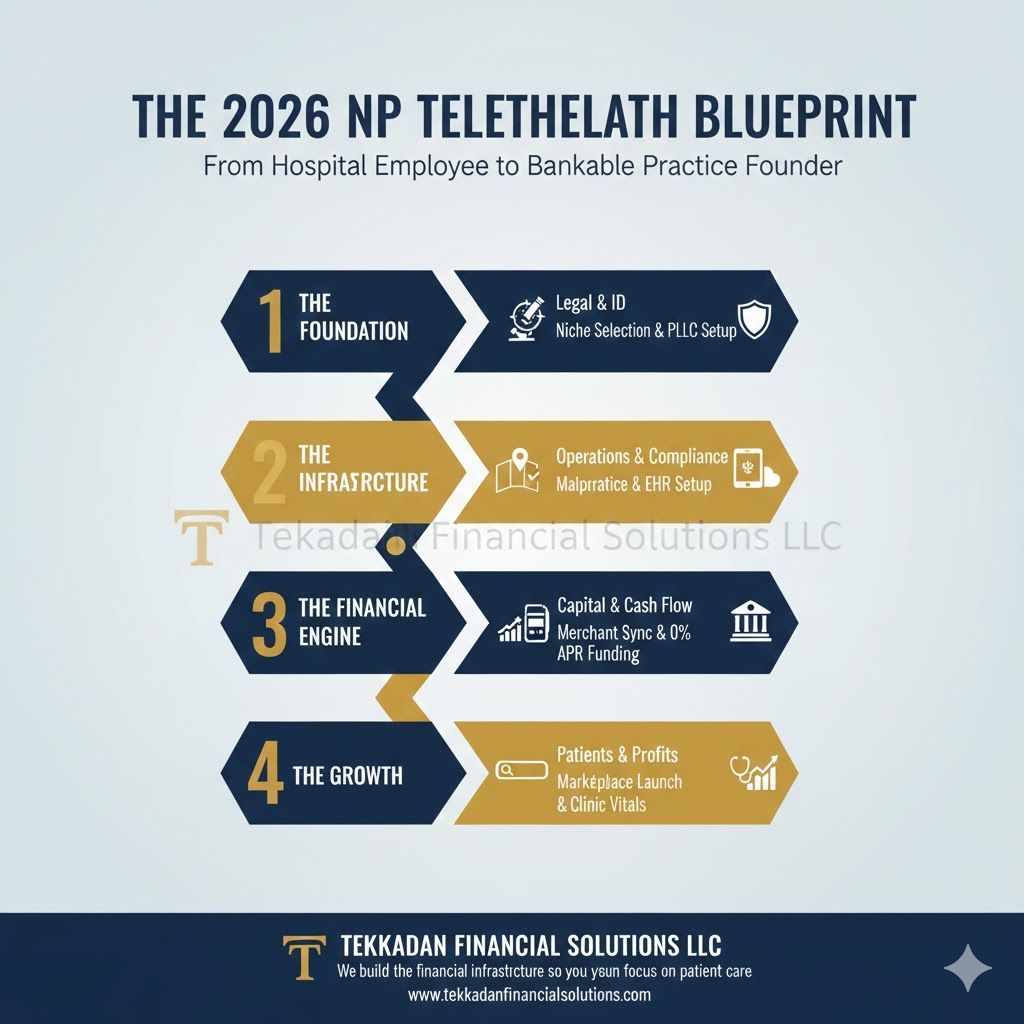
The 10-Step Telehealth/Telemedicine Launch Protocol for NPs
Select a Data-Proven Niche
Do not try to be a general family practice on day one. You cannot out-market massive hospital systems. Instead, you must specialize.
- The Data: High-margin niches like Medical Weight Loss (GLP-1s), Aesthetics, Hormone Replacement Therapy (HRT), and Psychiatric Mental Health yield the highest ROI for solo NP founders (Source: Nurse.org Private Practice Report, 2025).
- Action Step: Pick one specific patient problem to solve. Your website shouldn't say "Healthcare for Everyone." It should say, "I help women over 40 balance their hormones virtually."
Structure Your Legal "Shield"
You need a legal "house" for your business to protect your personal family savings.
- The Facts: Operating as a Sole Proprietor is a massive liability. Most medical professionals require a PLLC (Professional Limited Liability Company) or a Professional Corporation (PC), depending on state laws.
- Action Step: Hire a specialized healthcare attorney or a business formation service to register your PLLC in your home state. Expect this to cost between $400 and $3500+.
Establish Your NPI Type 2 and EIN
Your personal NPI Type 1 follows you. An NPI Type 2 belongs to your business.
- Why It Matters: This separation is the "secret key" for opening corporate bank accounts and applying for business funding. Without an NPI Type 2, commercial lenders view you as a high-risk hobbyist.
- Action Step: Apply for your free Employer Identification Number (EIN) at IRS.gov, then use it to immediately apply for your NPI Type 2(Group NPI) at the NPPES website.
Navigate State Practice Authority
Telehealth crosses borders, which means you must understand local laws.
The Data: As of 2026, 30 states and territories grant Full Practice Authority (FPA), meaning you do not need physician supervision (Source: American Association of Nurse Practitioners).
Action Step: Check the AANP state map. If you live or practice in a restricted state, you must secure a Collaborative Practice Agreement (CPA). Budget $500 to $2,000 per month for a collaborating physician.
Secure Telehealth-Specific Malpractice Insurance (The Cost-Saving Strategy)
Standard medical malpractice is a liability gap. A generic policy often does not cover digital communication, cross-state care, or software-related HIPAA breaches. Furthermore, if you choose the wrong type of policy, you will drain your startup budget before you even see your first patient.
The Strategy (Claims-Made vs. Occurrence): For a new telehealth practice, we highly recommend starting with a "Claims-Made" policy. It is significantly cheaper in the first few years compared to an "Occurrence-Based" policy. This keeps your monthly overhead extremely low while you are building your patient base and cash flow.
The Catch: A Claims-Made policy only covers you if the policy is active when the claim is filed. This means that if you ever close your practice, retire, or switch insurance providers later, you will eventually need to purchase "Tail Insurance." This ensures you remain covered for past patients even after the main policy ends.
Action Step: Purchase a Claims-Made policy and ensure you add a "Cyber/Telehealth" rider to cover digital data breaches. Providers like Berxi, NSO, and CM&F Group are highly rated, trusted options specifically tailored for NP-led practices.
Deploy an Integrated Technology Stack (EHR)
Your Electronic Health Record (EHR) is your virtual office building. While you must have a high-quality system, you should not lock up your precious startup capital in expensive, long-term software contracts. You need to save that cash for marketing and patient acquisition.
The Data: An automated, modern EHR reduces administrative labor by up to 10 hours per week, saving approximately $25,000 a year in wasted provider time (Source: Medscape Physician Burnout Report).
The Strategy: When you are just starting out, we highly recommend finding a service that offers true month-to-month, no-contract pricing. (Warning: Always read the fine print—some platforms advertise "monthly billing" but require a 1-year commitment). Furthermore, your EHR must feature integrated e-prescribing (eRx) so you can seamlessly and legally handle prescriptions for your remote patients.
Action Step: Choose a platform built for cash-pay and direct care that fits your specific clinical workflow. Providers like CharmHealth, OptiMantra, and SimplePractice are excellent options known for flexible billing. Do a few free trials and choose the interface that feels most comfortable to you before committing.
Fix the "Merchant Sync" Gap (and Protect Your Margins)
This is where the "financial chaos" starts for most NPs. Your credit card processor must integrate directly with your EHR to help save you hours on billing. But beyond the tech integration, you must protect your profit margins, because once you start scaling, those tiny transaction fees add up fast.
The Risk: If your payment processor and your EHR don't "talk" to each other, you have to manually enter payments. NPs who do manual entry lose an average of 3% to 5% of their revenue to missed invoices, failed subscriptions, and unreconciled fees. Furthermore, many processors charge monthly fees even if you see zero patients that month—a budget killer for a new startup.
The Strategy: When you are just starting, ensure your merchant account has no monthly fees for the months you don't process cards or see patients. As you grow, you want to switch to a merchant whose terms you can negotiate. (For context, when I helped my wife set up her practice, we paired OptiMantra with Fiserv to get that perfect, time-saving integration).
Action Step: Choose a merchant processor that natively integrates with your chosen EHR, and pick the pricing model that fits your current clinic volume:
Stripe (Flat Rate): Best for low volume and brand-new startups. It is easy to set up with no monthly fees, though the per-transaction fee is slightly higher.
Helcim (Interchange-Plus): Best for automatic scaling. They pass the true, wholesale cost of the credit card directly to you with a small markup, which makes it cheaper as your practice grows.
Stax (Subscription - $99+/mo): Best for high-volume practices processing $10,000+ per month. You pay a flat monthly fee but get access to direct wholesale rates with 0% markup, saving you thousands at scale.
Architect "Bankability" for 0% Funding
Before you drain your 401k or personal savings to pay for marketing or software, look for 0% APR Business Credit.
The Reality Check: While you are applying for business funding, the bank's algorithm will pull your personal credit profile first to determine your risk level. If your personal credit isn't optimized, you will get an automatic denial before a human underwriter ever looks at your application.
The Strategy: Once your personal credit is solid, your business must also look flawless on paper to get approved for high limits. Commercial lenders are 60% more likely to fund businesses that have a professional commercial address (no home addresses), a VOIP business phone number, and a dedicated business checking account.
Action Step: First, never mix personal and business expenses—set up a separate checking account today. Second, ensure your personal credit is clean. When your foundation is ready, you can apply for 0% APR startup funding through our trusted lending network here. (If you aren't sure if your business looks "bankable" yet, this is exactly what Tekkadan Financial Solutions helps NPs orchestrate before they apply).
Hack the Marketplace (Zocdoc & Local SEO)
You cannot wait 6 months for Google to notice your brand-new website. To survive your first 90 days, you need cash flow and booked appointments on day one.
The Data: 71% of patients now prefer booking medical appointments online through directory platforms rather than calling an office (Source: Zocdoc Patient Behavior Report, 2025).
The Strategy: You need to put your clinic exactly where patients are already searching. However, a major warning: these business listings cost money (either a monthly fee or a fee per new patient). Do not blow your entire marketing budget trying to be on every single website at once. We recommend sticking with just one or two of the major players in the market while you build your initial patient base.
The Top Marketplaces for NPs:
Zocdoc: The biggest player. Great for immediate bookings, but you pay a fee for every new patient who books.
Sesame Care: Excellent for cash-pay and direct-to-consumer telehealth.
Psychology Today: The absolute gold standard if you are a PMHNP (Psychiatric Mental Health Nurse Practitioner).
Push Health: Highly recommended for independent telehealth NPs, especially for niches like weight loss or HRT.
WebMD Care: Massive daily traffic and great for building domain authority.
Sharecare: A growing directory that patients use to find verified, highly-rated providers.
Action Step: First, pick one paid marketplace (like Zocdoc or Sesame) to start generating immediate cash flow. Next, build your free "Citations" by claiming your Google Business Profile, Yelp, Healthgrades, and Vitals pages. Ensure your Name, Address, and Phone number (NAP) are spelled exactly the same everywhere so Google trusts your business.
Implement the "Clinic Vitals" Formula
We want you to have a highly successful practice where you can provide amazing care to your patients while making a great living for yourself and your family. But to do that, you must treat your business like a patient.
The Mindset: Just like your patients need to know their lab numbers to stay healthy, an NP founder must know their business numbers to survive. If you don't know your numbers, you aren't running a business—you are running a charity.
The Strategy: You must track your ROI (Return on Investment) for every patient you see. As the founder, you should be reviewing your financial numbers daily or, at the very least, weekly. You cannot wait until tax season to find out if you made a profit.
Action Step: Keep a dashboard of these 5 critical "Founder Formulas" so you always know the exact health of your clinic:
The True Profit Per Visit Understand exactly what you keep from every single appointment.
Net Profit = Visit Fee - CAC + Merchant Fees + Tax Set-Aside
(Note: CAC = Customer Acquisition Cost. If you spend $100 on marketing to get 2 patients, your CAC is $50).
The Break-Even Point (The "Sleep Well" Number) Know exactly how many patients you must see each month just to keep the lights on. Once you hit this number, every patient after is pure profit.
Break-Even (Patients) = Fixed Costs /(Average Visit Fee - Variable Costs)
Don’t Build Your Telehealth Foundation Alone
The difference between a stressed-out NP working a messy side hustle and a confident Founder running a scalable, cash-based clinic comes down to one thing: Financial Infrastructure. My wife had the clinical brilliance to heal patients, but she needed a Business Architect to help her navigate the messy backend—the LLC setup, the merchant integrations, the 0% funding, and the bookkeeping. That is exactly why I built Tekkadan Financial Solutions. We work with you to build your accounting, bankability, and financial setup so you can focus on patient outcomes and enjoying your "freedom to move about the cabin."